Insights9th Jul 2026
Opening the black box: the science behind Marketing Mix Modelling

Article's author
Share article
By Olga Zaitseva, Head of Modelling Services at WPP Media
For as long as brands have invested in advertising, they’ve faced the same fundamental question: where does the next pound work hardest?
Should budget move from social into CTV? From DOOH into direct mail? And how do you make those decisions with confidence, rather than instinct?
Marketing Mix Modelling (MMM) exists to answer these questions, quantifying the return and incremental impact of every element of the media mix, and helping marketers invest with greater clarity and accountability.
MMM is sometimes described as a “black box”: opaque, overly complex, or difficult to interrogate. That perception often comes from limited visibility into how models are built, tested and interpreted. Our approach is designed to do the opposite - combining rigorous methodology with transparent processes and a clear focus on actionable insight.
To explain how this works in practice, it’s worth looking at how WPP Media builds and applies MMM, from data inputs through to validation and decision‑making.
Going granular
When calculating the optimal marketing mix, the quality and granularity of the data matters. At WPP Media, we prioritise the most detailed data available - including daily or weekly spend, ratings, impressions and clicks by channel, often segmented by creative or audience.
Take out‑of‑home as an example. We’ve moved beyond traditional, manual approaches to assembling OOH data, which can be slow and prone to error. Instead, we use a proprietary solution that automates data ingestion. By combining our own databases with Route (the UK industry standard), we can align spend and exposure on a daily basis, and analyse performance by environment and format.
This means we’re able to understand not just whether OOH works, but where, how and under what conditions it delivers the most impact.
Media data is only part of the picture. MMM also incorporates a wide range of external and internal factors, including competitor activity, economic indicators, seasonality and public holidays, alongside pricing, promotions, distribution and stock availability. The stronger the inputs, the more reliable the outputs.
Because of this, every project begins with an intensive data audit and harmonisation phase. This allows us to interrogate initial inputs, identify gaps or inconsistencies early on, and ensure the model is built on the clearest possible view of the underlying data.
The method behind the modelling
MMM has evolved significantly over the past two decades. As the advertising ecosystem has become more digital, the volume, speed and variety of available data has increased — bringing both opportunity and complexity.
Behind the relatively simple results marketers see sits a combination of algorithms, econometric techniques and specialist expertise. These models are built using industry‑standard, auditable statistical programming languages and draw on a range of approaches, including Bayesian methods, regularised regression, hierarchical models and Ordinary Least Squares.
Crucially, there is no single MMM algorithm. Techniques are selected based on the characteristics of the data, the business questions being asked and the dynamics of a particular market. There is no one‑size‑fits‑all solution — and no hidden “black box”.
To ensure robustness, all core statistical assumptions are rigorously tested. For example, carry‑over effects — the lingering impact of previous campaigns — are defined based on statistical significance, rather than pre‑set industry benchmarks.
Where required, we can clearly lay out the transformations, algorithms and tests used within each model, providing both transparency for advertisers and accountability for our own work.
Separating science from folklore
For those new to marketing science, MMM can sometimes feel like guesswork - more akin to reading tea leaves than analysing evidence. In reality, well‑constructed MMM is explicitly designed to remove assumptions, not reinforce them.
That misunderstanding tends to surface in three common myths.
1. “MMM overlooks non‑media factors”
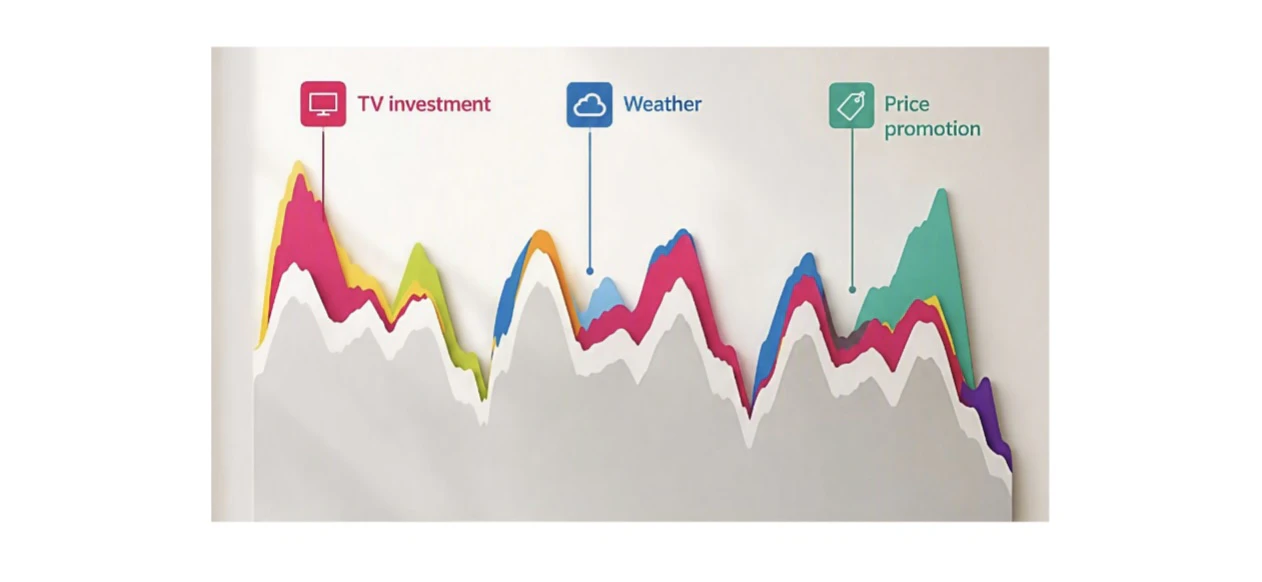
A frequent misconception is that MMM attributes too much impact to media by ignoring other drivers of performance. In practice, robust MMM frameworks explicitly include non‑media variables such as pricing, promotions, distribution, competitor activity, macroeconomic conditions and brand metrics.
By accounting for these influences, MMM isolates the true incremental impact of marketing rather than overstating its role.
2. “MMM assumes linear relationships between spend and outcomes”
Marketing rarely delivers constant returns, yet MMM is often assumed to make exactly that mistake. In reality, models account for diminishing returns, saturation effects and channel interactions. They also distinguish between short‑term sales response and longer‑term brand impact, creating a more realistic picture of performance over time.
3. “MMM over‑attributes sales to marketing”
Another common belief is that MMM inflates marketing’s contribution. In fact, the process starts by establishing a robust baseline — a data‑driven estimate of expected sales without marketing. Only once that foundation is defined can the true incremental value of each pound spent be assessed.
Beyond methodology, human expertise plays a critical role. By working closely with businesses from the outset and building a detailed understanding of their category and context, models can be shaped around specific needs rather than forcing those needs to fit pre‑defined templates.
Trust, but verify
Confidence in MMM depends not just on how models are built, but on how rigorously they are validated. Confidence in MMM depends not just on how models are built, but on how rigorously they are validated and embedded within broader effectiveness practices. This scrutiny extends beyond internal review. Our approach to effectiveness has been independently recognised through IPA Effectiveness Accreditation — a prestigious recognition awarded to agencies that demonstrate a strong commitment to business effectiveness and delivering measurable commercial outcomes for clients. In parallel, our MMM methodologies and outputs have also been tested through the detailed scrutiny involved in multiple IPA Effectiveness Awards submissions.
Alongside standard statistical diagnostics - including tests for autocorrelation, multicollinearity and parameter stability - we apply a series of additional checks to stress‑test our results.
Out‑of‑sample validation is conducted by holding back a portion of historical data and comparing actual outcomes with model predictions. We also replay historical scenarios and run future “what‑if” simulations to assess whether outputs remain logical and consistent.
One of the most demanding tests of any model is its predictive power. In some cases, MMM outputs are used directly for business forecasting, applying model coefficients to planned changes across media and non‑media drivers to estimate future sales performance. While forecast accuracy depends on both model robustness and the quality of input assumptions, this process provides a stringent and practical test of model reliability.
Finding the right mix
As data quality improves and modelling techniques continue to evolve, Marketing Mix Modelling is becoming an increasingly practical tool for real‑world decision‑making — not just a retrospective analysis.
At WPP Media, our focus is on using MMM to help businesses make clearer choices — grounded in robust methodology, transparent validation, and approaches that have stood up to independent industry scrutiny. If you’d like to explore how MMM could work for your organisation, please get in touch at [email protected].